You Don’t Need More Emails, You Need Better Timing (Here’s Proof)
If your solution to "low revenue" is to simply crank up the campaign frequency from two emails a week to five, I have bad news: You’re not marketing; you’re committing inbox arson.
Most founders and "freelance Klaviyo experts" operate on the Volume Fallacy. They believe that if they just shout louder and more often, more people will buy. In reality, you’re just accelerating the rate at which your best customers hit the "Unsubscribe" button.
You don't have a volume problem. You have a Timing Logic problem.
In the world of high-conversion email, how you say something is often more important than what you’re saying. If your timing is off, the most beautifully designed email in the world is just digital noise.how
The "Dead Zone": 3 Specific Timing Mistakes Killing Your ROI
Let’s move past the "best time to send" clichés. I don't care if "Tuesday at 10 AM" works for a generic study. I care about the behavioral windows where your customers are actually making decisions.
Here are the three most common ways brands fail at timing:
1. The "Laggard" Abandonment Window
Most brands wait 4 to 24 hours to send their first Abandoned Cart email. By then, the dopamine hit of the shopping experience has evaporated. The "need" has been replaced by "rationalization."
The Mistake: Waiting until the customer has moved on to a competitor or forgotten why they liked the item.
The Strategic Fix: Your first touchpoint should hit within 30–60 minutes. It needs to catch them while the tab is likely still open in their mobile browser.
2. The "Premature" Review Request
There is nothing that ruins a customer's perception of a brand faster than being asked for a 5-star review before the package has even cleared customs.
The Mistake: Using a static "14 days after order" trigger without accounting for shipping delays or product "time-to-value."
The Strategic Fix: Integrate your email tool with your shipping carrier (like AfterShip or Wonderment). The review request should trigger X days after "Delivered," not "Ordered." Furthermore, if you sell a supplement that takes 30 days to work, asking for a review on day 5 is an insult to the customer's intelligence.
3. The "Flow Collision" (The Inbox Pile-Up)
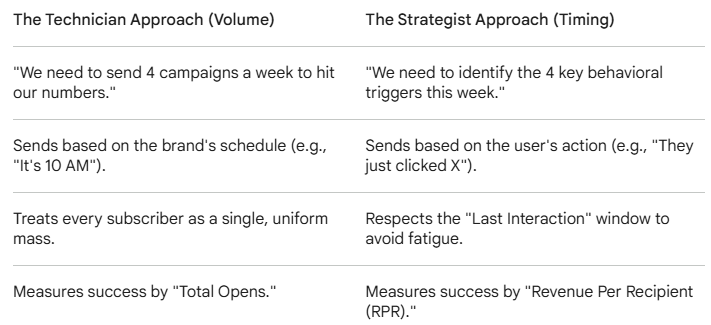
This is the hallmark of a technician-led account. A customer signs up for your newsletter (Welcome Flow starts), abandons a cart (Cart Flow starts), and you also send a store-wide blast that same afternoon.
The Mistake: Your customer receives three different emails with three different vibes in six hours. You look desperate and disorganized.
The Strategic Fix: You need Smart Sending and Global Frequency Caps. A true strategist ensures that if a user is in a high-intent flow (like Abandoned Cart), they are automatically suppressed from receiving generic "Tuesday Blasts."
Technician vs. Strategist: The Timing Comparison
The Proof is in the "Quiet"
The most profitable accounts I manage often send fewer emails than they did before I took over. Why? Because we stopped screaming at the people who weren't listening and started whispering at the people who were already reaching for their wallets.
When you master timing, your open rates go up, your deliverability improves (because ISPs like Google see people actually engaging), and your revenue grows—even if your "send volume" drops.
If you’re tired of "batching and blasting" and want to see how behavioral triggers can do the heavy lifting for you, would you like me to map out a custom Timing Logic Flow for your top three products?
